Adoptive parents describe one of their most important ongoing responsibilities in a simple phrase: telling the story.
The story of how a child came to be in their family. The story of the waiting and the hoping. The story of the day everything changed. Child psychologists who specialize in adoption are consistent: children who understand their adoption story in positive, coherent terms from an early age develop stronger self-concept, greater resilience, and healthier attachment.
A personalized adoption storybook gives families a beautiful tool for exactly this purpose — with your family's actual faces in the illustrations, telling a story that exists nowhere else in the world.
Why Adoption Stories Matter So Much
The research on adoptee identity development is clear. Children who have access to their adoption story from early childhood:
- Develop stronger sense of self and family identity
- Experience less confusion and anxiety about their origins
- Approach the topic with openness rather than shame
- Build more secure attachment with adoptive parents
A personalized storybook is not the only tool for this — but it is one of the most powerful. A child who can hold a book, see themselves in the illustrations, and hear the story of their family's love told in a warm narrative is receiving something fundamentally different from a verbal explanation.
The story becomes something they can return to. At three, they point at the pictures. At five, they can read some of the words. At eight, they read it alone. At fifteen, they read it with different eyes. Throughout all of it, the core message remains constant: you were chosen, and you are home.
What Makes This Storybook Different From Others
Most personalized children's books personalize by name only. Your child's name appears in a pre-written story alongside a generic illustrated character who looks nothing like them.
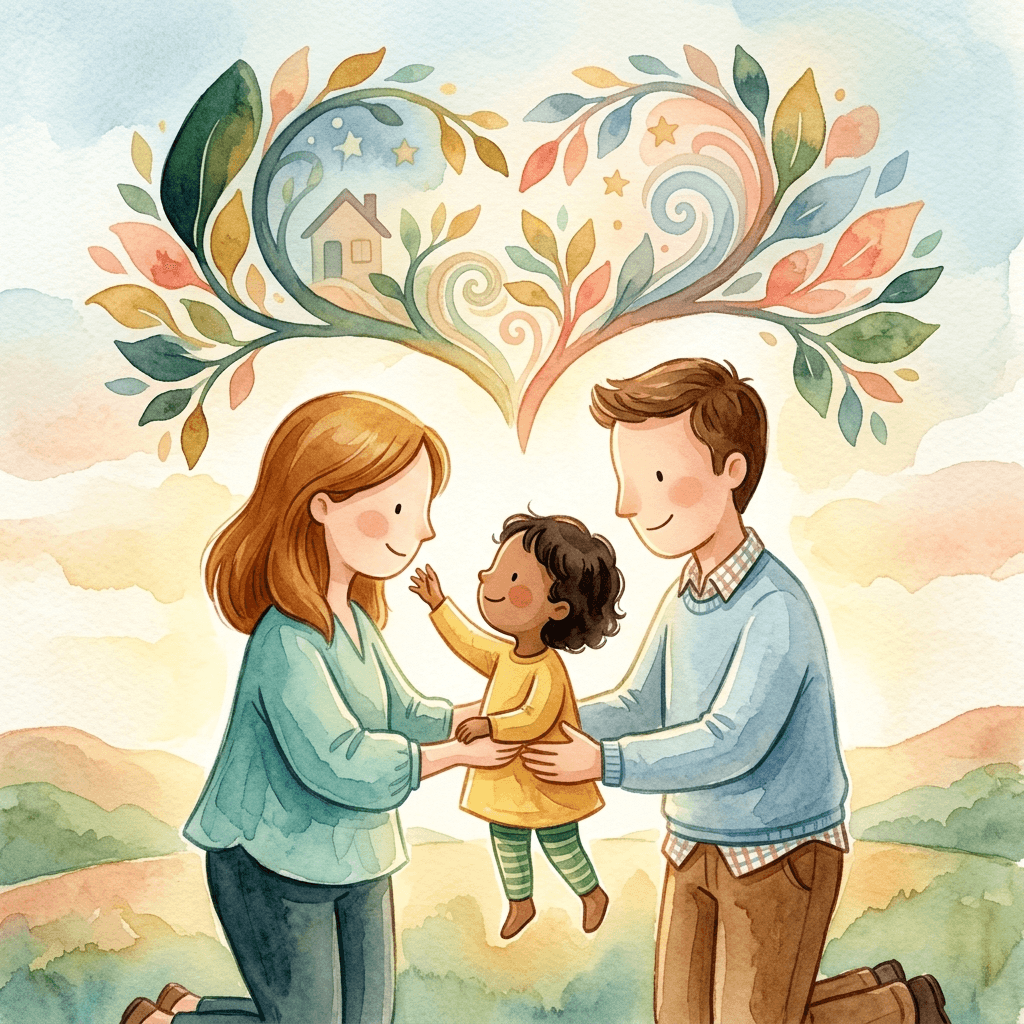
A Lullaby storybook works differently. Upload a photo of your child and they appear in the illustrations — their actual face, their specific appearance — alongside the other characters you include. For an adoption storybook, this means the actual family that exists, illustrated as they actually look.
This specificity matters for adoption stories in particular. The story is not about any adopted child. It is about this child, in this family, with these parents. That is the story worth telling.
Story Ideas for Adoptive Families
Browse the full collection at Lullaby's adoption story starters.
"How You Came to Our Family"
The origin story. A child learns — in age-appropriate, loving terms — the journey that brought them to their forever family. The waiting, the hoping, the day everything changed, and the profound belonging that followed.
Best for: early childhood reading (from infancy onward), a keepsake for the child to keep forever, explaining adoption to young children.
"Gotcha Day: The Day Our Family Became Complete"
A Gotcha Day celebration story recounting the specific day a child officially joined their forever family — the courtroom or ceremony, the celebration, the first night home. An annual re-read becomes a tradition.
Best for: Gotcha Day anniversary gift, adoption finalization keepsake, yearly tradition.
How to Write an Adoption Story Prompt
The most important principle: center the story on belonging, love, and choice — not on loss or what came before.
Good frames to work from:
The puzzle frame: "Before you arrived, our family felt like a puzzle with a beautiful missing piece. The day we found you, everything clicked into place."
The anticipation frame: "For a long time, we waited. We prepared a room. We chose a name. We imagined you. And then you arrived, and you were everything we had imagined and more."
The choice frame: "Some families grow through birth. Ours grew through love and choice — and we would choose you, again and again, every single time."
The Gotcha Day frame: "On the most important Tuesday of our lives, we walked into a room and you were there. We held you and the waiting ended and the family began. That day, we became whole."
Avoid:
- Framing adoption as rescue or saving
- Language centered on what the child was "without" before
- Heavy references to birth family complexity at young ages (save nuance for later readings when the child is older)
Include:
- Real details: where the child came from, what the first meeting felt like, who was in the room
- The family's emotional experience: the relief, the joy, the overwhelm
- The first night in the forever home
- The names the child calls their parents
For Gotcha Day Specifically
Gotcha Day — the anniversary of the day an adoption became official — is an important milestone for many adoptive families. A storybook created specifically for this day gives the child an annual keepsake they can re-read as they grow, watching their understanding of the story deepen each year.
Many families create a Gotcha Day book and re-read it together every year on the anniversary. By the time the child is ten or twelve, the earlier readings have become their own memory, layered on top of the story.
A Keepsake Unlike Any Other
Most keepsakes eventually lose their meaning. Objects get lost, photographs fade, memories blur.
An adoption storybook is different because it carries meaning explicitly — in the words, in the illustrations, in the act of reading it together. It is designed to be re-read, and each reading adds another layer of warmth to the story it tells.
For an adoptive family, that story — told with love, specificity, and the actual faces of the people who belong to each other — is one of the most important things you can give your child.
Related Reading
- Best Personalized Children's Books in 2026 — All personalized book options compared
- AI Children's Book Generator — How Lullaby compares to other AI book tools
- How to Write Great Story Prompts — Getting the most out of your AI story generator