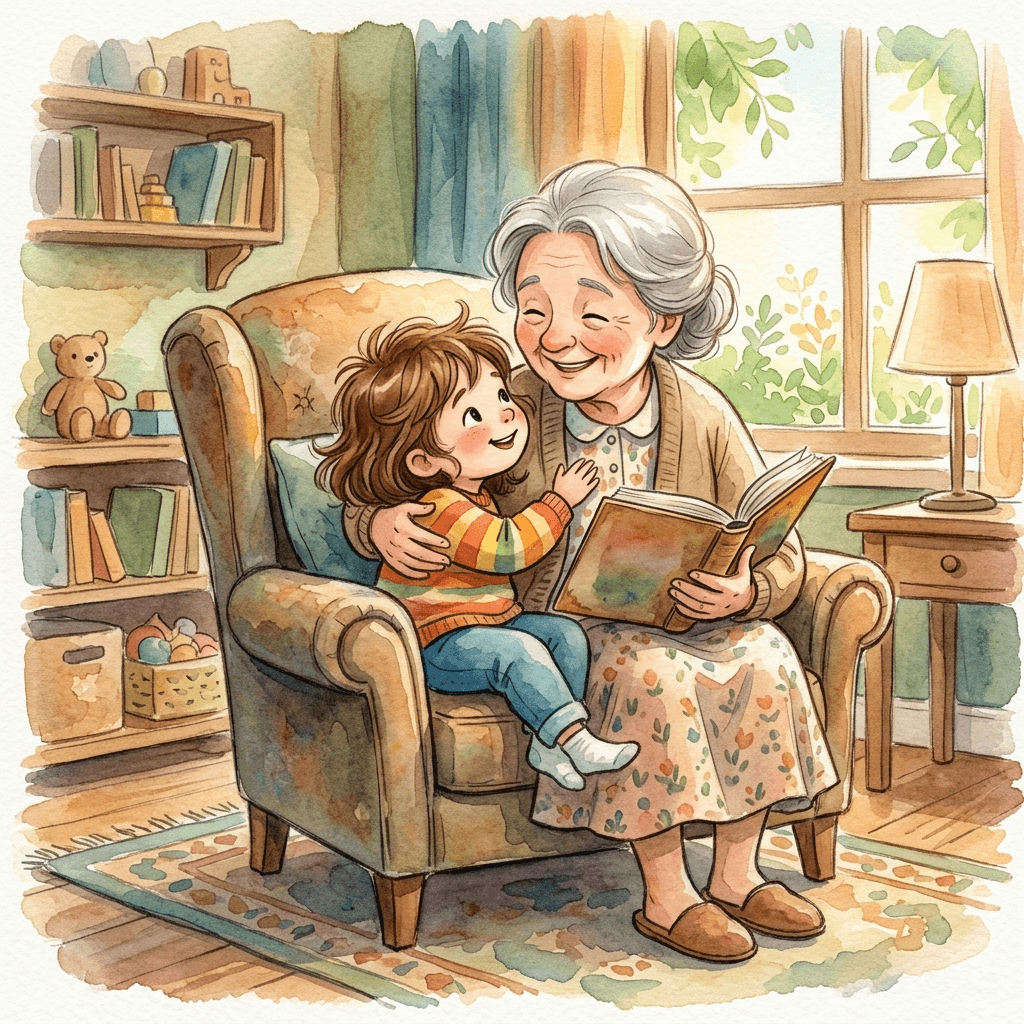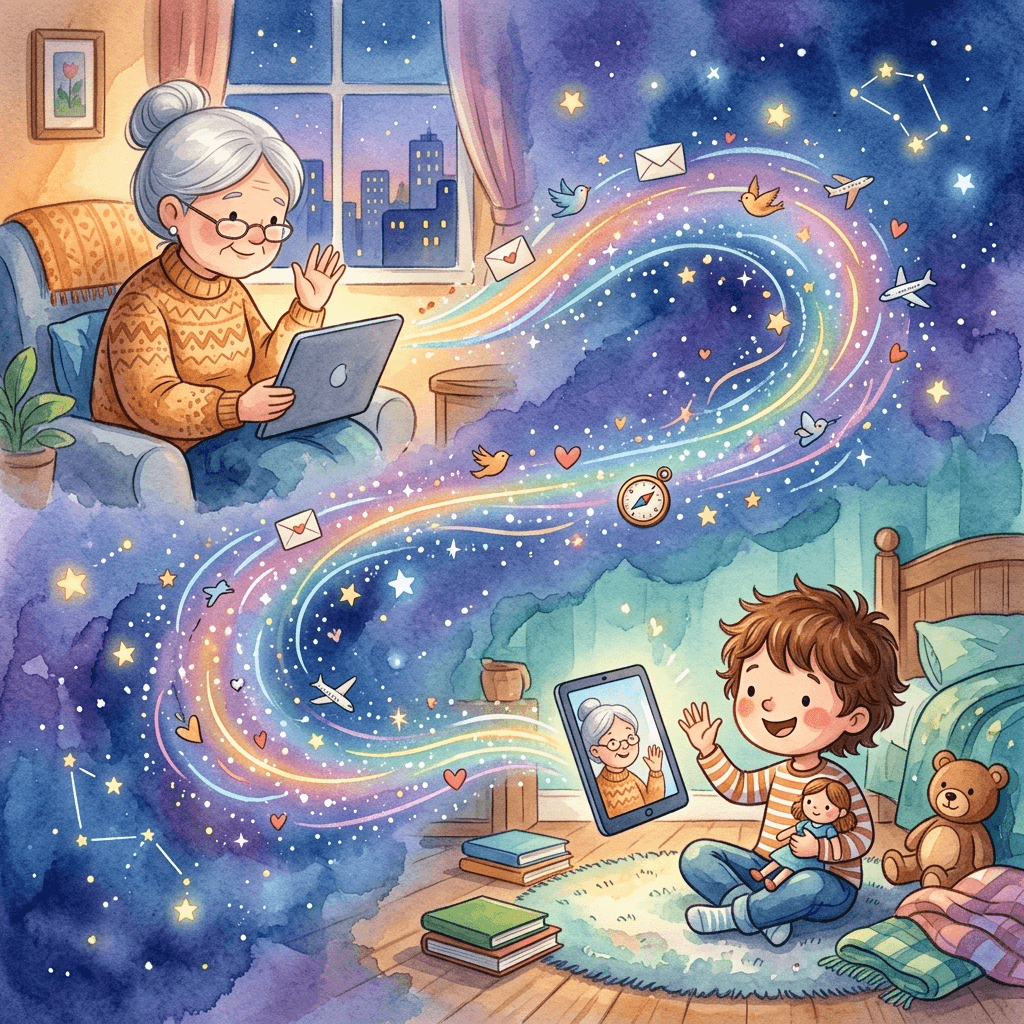
The hard part about being a long-distance grandparent isn't choosing a gift. It's that a parcel arriving is a one-way event. It gets opened, admired for a moment, and absorbed into a room you've never stood in.
The gifts that work across distance have something in common: they produce a moment you're both in. Sometimes that's your face in a book, sometimes your voice on a recording, sometimes a project happening at both ends of a video call. Sixteen of them below, with the honest caveat on each.
Gifts That Make a Shared Moment
1. A storybook with both of you illustrated in it
Who it's for: grandchildren roughly 2–9, and especially the ones who only see you a few times a year. This is what we build at Lullaby, so weigh that as you like — but it's the idea on this list that most directly attacks the distance problem. You upload a photo of your grandchild and a photo of yourself, and both of you become illustrated characters in a story you shape: up to four characters, so a sibling or the dog can join. There are 7 art styles, and creating and previewing is free with no credit card.
The practical bit for long distance: the $14.99 digital book is ready in minutes and can be opened at their end tonight, which means you can create it on a Tuesday and read it together over video on the Wednesday. Then the printed hardcover ($39.99, or softcover $29.99, or layflat $59.99) ships to their house as a second, separate step — the thing that stays on the shelf and gets read at bedtimes you're not there for.
What to watch for: it is digital-first, so the print is an added step rather than one purchase. And it needs a decent, clear, front-facing photo of you, which is the part most grandparents underestimate. Dig one out before you start. More on how it works is on the AI children's book page.
2. Matching copies of the same book
Who it's for: 3+. Two copies of the same title, one at each house, and a standing call to read a chapter at the same time.
What to watch for: it only works if the call is actually scheduled by the adults. Left to drift, it dies in three weeks.
3. A subscription that arrives monthly
Who it's for: 4+. A magazine or a book club that lands with your name attached eleven more times after Christmas.
What to watch for: ask the parents about post volume and clutter tolerance before setting up a recurring delivery to someone else's house.
4. A jigsaw of a photo of the two of you
Who it's for: 4+. It's a picture of you that they have to assemble, which is a strange and rather effective way of getting looked at for an hour.
What to watch for: keep the piece count age-appropriate. A frustrating puzzle gets abandoned face-down. For more one-of-a-kind gifts for grandchildren along these lines, see our broader list.
Your Voice, Recorded
5. A recordable storybook
Who it's for: 1–6, and it's the strongest single idea for the youngest end. A book that plays your voice reading it gets played at bedtime, repeatedly, on nights you're not there.
What to watch for: record it in a quiet room, and record it slowly. Background noise and rushing both wreck the effect.
6. An audiobook you record yourself
Who it's for: 3+. A phone voice-memo of you reading three chapters, sent as a file. Costs nothing, and older grandchildren keep them.
What to watch for: send it to the parents rather than direct, and check how they want to play it.
7. A voice message keepsake
Who it's for: any age. A small recordable button or box with a message on it — for the youngest, a good-night message they can press themselves.
What to watch for: button batteries. Check the enclosure is properly secured for the child's age.
8. A recorded lullaby or family song
Who it's for: 0–4. A song you sang to their parent, sung again. Even a slightly wobbly recording is the one they'll ask for.
What to watch for: don't over-produce it. The wobble is the point.
Projects You Do Together, Apart
9. A shared cooking kit and a video call
Who it's for: 4+. Send the dry ingredients and a written-out family recipe, keep the same ingredients at your end, and cook it simultaneously on a call.
What to watch for: agree a time with the parents that isn't a mealtime. Cooking at 5pm on a school night helps nobody.
10. Two of the same building or craft set
Who it's for: 4–10. A KiwiCo crate, a model, a Magna-Tiles set — one at each house, built together on a call.
What to watch for: buy the same version, not the "similar" one. Mismatched parts derail the whole thing.
11. A letter-writing kit
Who it's for: 5+. Stamped, addressed envelopes, paper, stickers — everything needed to write to you without an adult having to organise it.
What to watch for: pre-address the envelopes to you. Removing that step is what makes the difference between two letters and twenty.
12. A shared reading challenge
Who it's for: 6+. A list of books you'll both read this year, a chart to tick, and a call after each one.
What to watch for: read them yourself. Children spot a challenge that only runs in one direction immediately.
Practical Distance-Closers
13. A digital photo frame you can send pictures to
Who it's for: any age, in the child's own room. You send a photo from your kitchen and it appears on their shelf.
What to watch for: set it up completely before sending it. A frame that needs the parents to configure an account may sit in a box for months.
14. A children's video-call device or account
Who it's for: 3+, so the child can start a call rather than waiting for an adult to initiate one.
What to watch for: entirely the parents' decision. Ask first — this one touches screen-time rules and you don't want to gift a policy argument.
15. A membership to something near them
Who it's for: any age. A zoo, museum, or science centre in their city, paid by you, used all year.
What to watch for: check it covers the accompanying adults. A child-only membership is no use to anyone.
16. A visit, planned and booked
Who it's for: every age, and it's the one nothing on this list actually replaces. Booked dates, put in a card, with a countdown.
What to watch for: book it before you write the card. A promised visit with no date attached is not a gift.
If It's for Christmas
The distance problem gets worse in December, because everything ships slower and international transit adds its own delay on top.
Lullaby's printed books are made to order, and shipping runs slower the deeper into December you get — order early, and if you're shipping to a different country from your own, add even more margin. Other makers work the same way, so check their site for current timelines.
If it's too late for print: digital doesn't have that constraint. Create the book, share it, and schedule a video call to read it together on Christmas morning — then order the printed hardcover in January, when it arrives as its own separate small event rather than competing with everything else under the tree. For a seasonal plot, the Christmas story starters save you writing from scratch.
Put Yourself in Their Story
FAQ
What is the best gift for a grandchild who lives far away?
One that produces a shared moment rather than just an object. A book with both of you illustrated in it, a recorded story in your own voice, or a project you do together over video all give the child something to do with you. Gifts that only arrive get opened once; gifts that create an occasion get returned to.
How do long-distance grandparents stay part of a young child's life?
Repetition and presence in the objects around them. Small children build familiarity through repeated exposure, so a book featuring your face read at bedtime several times a week does more than a monthly video call. Both together do more than either alone.
Can I be in the story of a personalized book with my grandchild?
Yes. On Lullaby you can include up to four characters, so a grandparent, the grandchild, a sibling, and a parent can all appear as illustrated characters built from their photos. That is what makes it a book about the relationship rather than a book about the child that you happened to buy.
What do I send if it's too late for a printed gift to arrive in time?
Anything digital. A personalized digital storybook is ready in minutes and can be opened at the other end the same evening, with a printed copy following later. A scheduled video call where you read it together turns the digital version into an occasion rather than a file.
How do I choose a gift when I do not know what my grandchild is into right now?
Ask the parents, and ask specifically — not what the child wants, but what they talk about constantly. Then build the gift around that. Distance makes it easy to buy for the child you remember from your last visit rather than the one they are now, and children notice the gap.
Related Reading
- The Best Personalized Grandparent Gift — a storybook starring Grandma, Grandpa, and your child
- Personalized Gift Ideas for Kids in 2026 — ten more ideas for the child who has everything