"Why can't I just be like everyone else?" It's a question every child asks at some point. When they're the only one who doesn't like the popular game, when their interests seem strange to their peers, when something about them just feels... different.
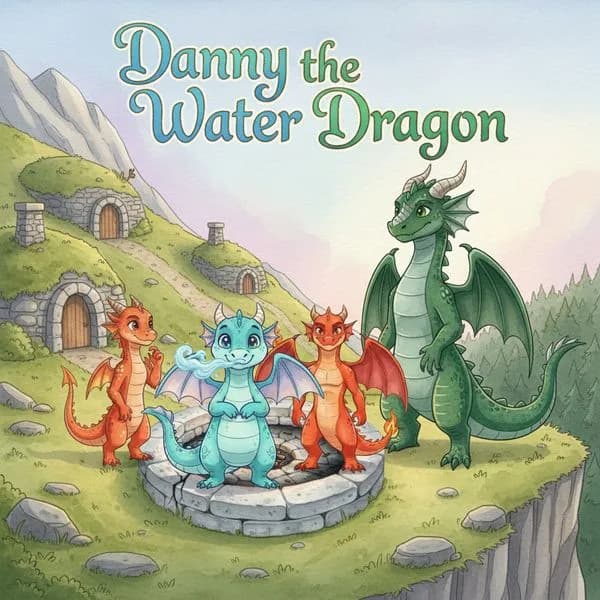
Danny the Water Dragon tackles this universal childhood experience through an imaginative tale of a young dragon who breathes water instead of fire—and discovers that his difference is actually his greatest gift.
Danny the Water Dragon is a children's story about a young dragon who breathes water instead of fire, teaching children ages 6-8 that differences are gifts, not flaws.
A Dragon Who Doesn't Fit In
High in the misty mountains lives a village of fire-breathing dragons. All of them can produce roaring, crackling flames—all except Danny. When Danny tries to breathe fire, only water comes out.
At first, Danny thinks it must be a mistake. He puffs out his cheeks and tries again and again. But no matter how hard he tries, his breath stays wet. When the other dragons gather to roast marshmallows, Danny's breath leaves them soggy. When they light birthday candles, Danny's attempt washes them cold and dripping.
The other dragons snicker. Danny's cheeks burn with embarrassment—hotter, ironically, than any fire he could produce. He starts staying out of the way, watching from the edges, wondering why he had to be born so different.
When Difference Becomes Destiny
Then one day, something unexpected happens. "The forest! It's on fire!" Ember cries. The dragons rush to the cliff's edge and watch in horror as flames devour the trees below. They try breathing fire at it—but fire only feeds fire. The blaze roars back bigger than before.
Danny's heart pounds. He knows what he has to do, even though his voice shakes when he says it: "Let me try."
The other dragons look at him doubtfully. "You don't have fire," someone points out. "I know," Danny replies. "But I have water."
What happens next transforms everything. Danny leaps from the cliff, spreads his wings, and circles the burning forest, drenching the flames with his breath. Again and again he swoops down, releasing torrents of water until the fire becomes nothing but a memory of smoke.
"Your Difference Is Not a Mistake"
When Danny lands in the clearing, the dragons on the cliff stare in stunned silence. Then Elder Orion speaks the words that give this story its heart: "Your difference is not a mistake. It is a gift."
This single line captures the story's profound message. Danny didn't need to change. He didn't need to learn to breathe fire. What he needed was a situation where his unique ability could shine—and the courage to use it when the moment came.
The central message: "Your difference is not a mistake. It is a gift." This reframing helps children see their unique traits as potential strengths waiting for the right moment.
After reading, ask your child: "What's something special about you that makes you different from your friends?" Help them see their differences as potential superpowers waiting for the right moment.
The Psychology of Feeling Different
Understanding why stories like Danny's resonate so deeply requires a look at child development. Between ages 5 and 8, children enter what psychologists call the "social comparison stage." They begin actively measuring themselves against peers—noticing who runs fastest, who reads best, who fits in most easily.
When Children Start Comparing Themselves
Research from developmental psychology shows this comparison process is natural and even healthy in moderation. But for children who notice they're different in ways that don't seem valued—whether that's a learning difference, a unique interest, or simply a personality that doesn't match the crowd—this stage can be painful.
The American Psychological Association notes that children who can articulate what makes them unique develop stronger self-esteem than those who view their differences as defects. This is exactly what Danny's story provides: language and a framework for understanding difference as potential rather than problem.
The Emotional Cost of Hiding
Danny's response to feeling different—staying out of the way, watching from the edges—mirrors what many children do. They learn to hide what makes them unique, hoping to avoid ridicule. But this hiding comes at a cost: anxiety, loneliness, and a fragmented sense of self.
Stories offer a safe way to explore these feelings. When children see Danny struggle with the same emotions they experience, they feel less alone. And when they see him triumph not despite his difference but because of it, they glimpse a different possible future for themselves.
This is why stories help children overcome fears in ways that direct advice often cannot. Narrative creates emotional distance while simultaneously building connection.
Why Dragon Stories Resonate with Children
Dragons have captivated children's imaginations across cultures for millennia. But why do these mythical creatures make such effective vehicles for teaching life lessons?
Dragons as Symbols of Transformation
Dragons represent power, mystery, and transformation. In Danny's case, the dragon framework allows the story to explore difference through a safe metaphorical distance. A child who might resist a story about "a kid who's different" readily engages with "a dragon who breathes water."
The elemental powers of dragons—fire, water, ice, lightning—tap into children's natural fascination with natural forces. Every child has wondered what it would be like to control the elements. Danny's water-breathing ability feels both fantastical and somehow plausible within the story's logic.
Fantasy Creates Emotional Safety
When children read about Danny's embarrassment at the marshmallow roast, they can feel the emotion without the vulnerability of reading about a human child in a school cafeteria. This emotional safety allows them to process difficult feelings more openly.
The fantasy setting also makes the resolution feel more possible. In the real world, differences don't always lead to dramatic moments of heroism. But in Danny's world, the connection between his unique ability and the forest fire feels natural and inevitable—giving children hope that their own moments of recognition will come.
Teaching Self-Acceptance Through Story
What makes Danny the Water Dragon so effective is how it handles the emotional journey of being different. The story doesn't minimize Danny's pain. We feel his embarrassment when the marshmallows turn soggy. We understand his isolation when he starts staying out of the way.
Validating the Emotional Journey
This validation is crucial. Children who feel different need to know their feelings are real and understood before they can move toward acceptance. The story meets them where they are, then shows them a path forward—not by changing who they are, but by discovering the value in their uniqueness.
Many well-meaning stories about difference skip the painful parts, jumping straight to "being different is great!" Danny's story earns its hopeful ending by first honoring the genuine difficulty of feeling like you don't belong.
The Forest Fire as Metaphor
The forest fire isn't just a plot device. It represents those moments in life when the very thing that made us feel like outsiders becomes exactly what's needed. Every child who feels different carries a gift waiting to be discovered.
For some children, that moment comes when their quiet observation skills make them the one who notices a friend is struggling. For others, it's when their unusual hobby becomes the solution to a group project. Danny's story plants the seed: your difference might be exactly what the world needs.
Discussion Questions for Parents
Reading Danny's story together creates natural opportunities for meaningful conversations. Here are prompts to deepen the experience:
Before Reading
- "Have you ever tried really hard to do something that everyone else seemed to find easy?"
- "What do you think makes someone special?"
During Reading
- "How do you think Danny feels when the other dragons laugh?"
- "Why do you think Danny offered to help even though he was scared?"
- "What would you do if you were Danny?"
After Reading
- "Have you ever felt like Danny—like something about you was different from everyone else?"
- "Can you think of a time when being different helped you or someone you know?"
- "What's something unique about you that might be a hidden superpower?"
The best conversations happen naturally. Don't force these questions—let your child's reactions guide you. Sometimes a simple "What did you think?" opens more doors than a structured discussion.
Dreamy Watercolor Illustrations
The story is illustrated in a dreamy watercolor style with soft brush strokes, translucent layers, and gentle palettes. This hand-painted aesthetic creates a storybook atmosphere perfect for bedtime reading.
Why Watercolor Suits This Story
The watercolor approach particularly suits this story's emotional texture. The soft, flowing colors mirror Danny's gentle nature, while the luminous washes suggest the magic underlying his unique ability. When Danny finally saves the forest, the illustrations capture both the drama of the moment and the warmth of his triumph.
Young readers respond strongly to the watercolor style's dreamy quality—it invites them into the story's world without overwhelming their senses before sleep. The science of bedtime stories shows that calming visuals help children transition to sleep, and watercolor illustrations naturally support this wind-down process.
Visual Storytelling Details
Watch for how the illustrations use color to reflect Danny's emotional journey. Early pages use cooler, muted tones during his isolation. As Danny discovers his purpose, warmer golds and oranges enter the palette—even as he's dousing flames with water. This visual language helps pre-readers follow the emotional arc even before they can decode all the words.
Building a Library Around Self-Acceptance
Danny's story works beautifully as part of a broader collection of books that celebrate uniqueness and build emotional resilience.
Stories That Complement Danny
Consider pairing Danny the Water Dragon with stories that explore similar themes from different angles:
- Stories about different abilities — Characters who discover that what seemed like a limitation becomes a strength
- Stories about unique interests — Children whose unusual hobbies or passions lead to unexpected friendships
- Stories about being new — Characters navigating the challenge of standing out in unfamiliar environments
The best personalized children's books allow you to create custom stories that directly address your child's specific situation, making the lessons even more personal and powerful.
From Picture Books to Chapter Books
As children grow, they can revisit themes of difference and self-acceptance through increasingly complex stories. Danny provides an excellent foundation—a reference point your child can return to as they encounter new situations where being different feels challenging.
Perfect For
Best suited for children ages 6-8, when social comparison and self-awareness are developing rapidly.
- Ages 6-8 — Rich vocabulary and nuanced emotions suited for early readers
- Children who feel different — Validates their experience while offering hope
- Bedtime reading — The gentle watercolor style and affirming ending promote peaceful sleep
- Classroom discussions — Excellent for lessons on acceptance and celebrating diversity
- Siblings of different abilities — Opens conversations about how everyone has unique gifts
- Children starting new schools — Helps reframe the anxiety of standing out
- Kids with unique interests — Validates passions that peers might not understand
Your Child as the Hero
Every child has something that makes them unique—something that might sometimes feel like a burden but could become their greatest strength. With Lullaby, you can create a personalized story where your child discovers their own special gift.
Imagine your child seeing themselves illustrated in beautiful watercolor, facing a challenge that mirrors something real in their life, and discovering that the very thing that makes them different is exactly what saves the day.
What makes your child different? That could be the beginning of their very own story about becoming exactly who they were meant to be.
Looking for more stories that help children navigate big emotions? Explore our collection of personalized bedtime stories designed to help your child see themselves as the hero of their own adventure.