It's 4 AM. Tiny footsteps pad down the hall. "Is it morning yet?" Every parent of a toddler knows this scene too well. Early waking is one of the most common—and exhausting—sleep challenges families face.
It's Still Night, Jonah is a gentle, rhyming story that helps children understand when it's still time to sleep, and guides them back to bed with warmth and reassurance.
It's Still Night is a rhyming bedtime story that teaches toddlers ages 2-5 to recognize when it's still nighttime and self-soothe back to sleep—without getting out of bed.
A Story That Speaks to Early Risers
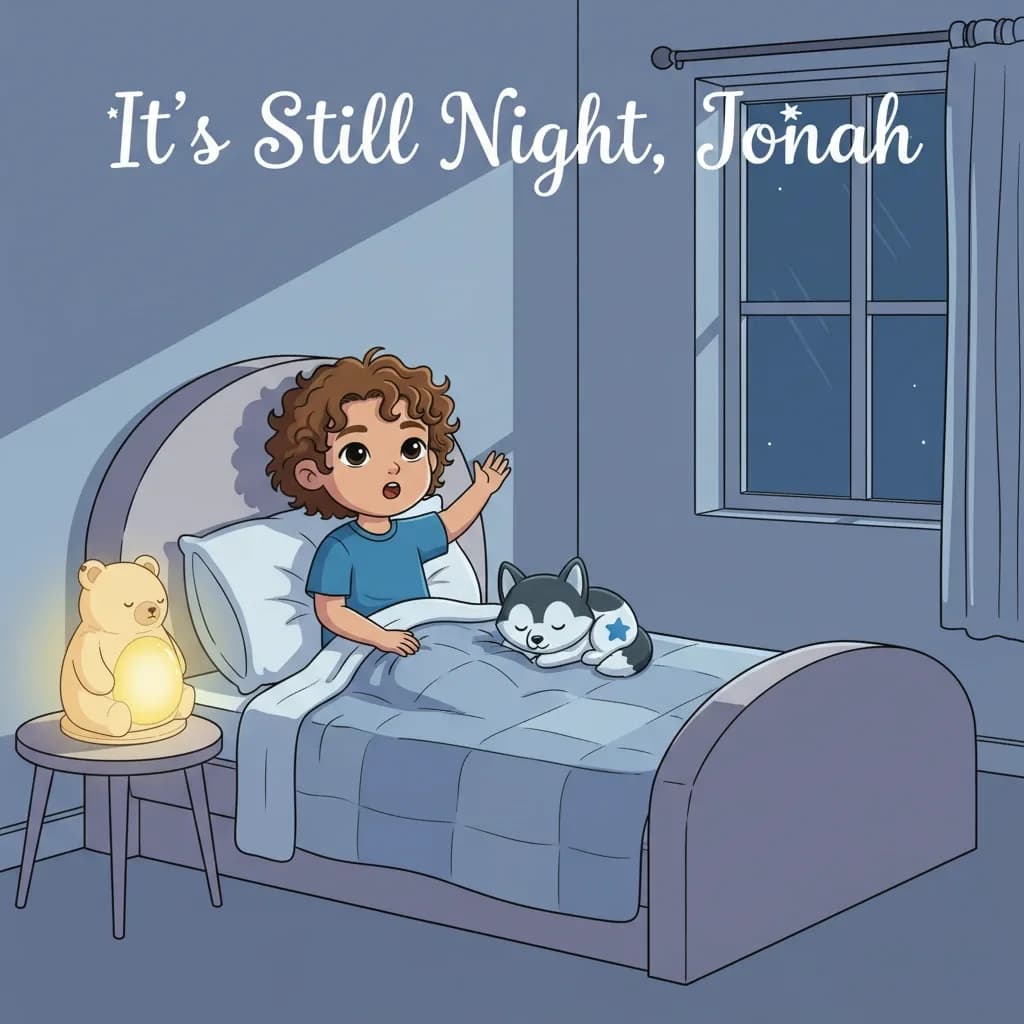
Little Jonah wakes up and sighs, "Good morning, world!" But something isn't quite right. The sun is still sleeping. The moon hangs high. The stars aren't racing across the sky. Nighttime still holds this gentle place.
Jonah tries calling to the sun—"Wake up, Sun!"—but the sun just snores behind cloudy walls. Even his bear-shaped lamp has gone to bed, its soft yellow glow dimmed for the night. "Night-night, Jonah," the bear seems to say. "It's still my time."
Through gentle rhymes, Jonah realizes what he needs to do. He finds his soft Husky toy, holds it close, and settles back into bed. Eyes grow heavy, breathing slows, and dreams tiptoe in. When the sun finally wakes, warm and bright, Mom comes in with a hug and a kiss. "Good morning, Jonah"—and a brand-new day begins with love, light, and a bright "hooray."
The Science of Early Waking in Toddlers
Understanding why your child wakes at 4 or 5 AM can help you respond with patience rather than frustration. Early waking in toddlers aged 2-5 is developmentally normal, though that doesn't make it any less exhausting.
Why Toddlers Wake Before Dawn
Several factors contribute to early waking:
Sleep cycle length: Toddlers cycle through light and deep sleep approximately every 90 minutes. Around 4-5 AM, after several cycles, they enter a period of lighter sleep and may wake fully instead of transitioning to another cycle.
Circadian rhythm development: The internal body clock that regulates sleep-wake cycles is still maturing in young children. Their systems are particularly sensitive to light, which is why even small amounts of early morning light can trigger wakefulness.
Sleep pressure: If bedtime is too early or naps are too long, children may simply have gotten enough sleep by 5 AM. Their bodies are ready to wake, even if the household isn't.
Early waking in toddlers aged 2-5 is developmentally normal due to their 90-minute sleep cycles and still-developing circadian rhythms. Stories that model self-settling behavior help children learn to stay in bed.
What the Research Says
The science of bedtime stories reveals that narrative interventions can genuinely improve sleep behaviors. When children hear stories that model desired behaviors—like Jonah finding his comfort object and going back to sleep—they're more likely to internalize those behaviors themselves.
This isn't just wishful thinking. Studies in developmental psychology show that young children learn social and behavioral scripts primarily through observation and narrative. A story character who successfully navigates a challenge becomes a template the child can follow.
Teaching Sleep Skills Through Story
What makes this story so effective is how it models the behavior we want to see. Instead of telling children "go back to sleep," it shows them the path through Jonah's eyes.
The Power of Narrative Modeling
The story acknowledges the child's experience—yes, you're awake, and that's okay. Then it gently redirects: the world is still sleeping, and you can be part of that peaceful quiet. Find your comfort object. Settle back in. Trust that morning will come.
This is the power of narrative modeling. Children learn through stories in ways that direct instruction often can't reach. When they see Jonah make the choice to go back to sleep, they internalize that as a possibility for themselves.
Research shows this approach is more effective than simply telling children what to do. Stories engage emotional processing and memory in ways that instructions don't. Jonah's journey becomes something your child can reference when they find themselves awake in the dark.
Why Personalized Stories Work Better
There's something powerful about seeing yourself in a story. When children recognize themselves as the protagonist, a psychological process called "self-referential encoding" kicks in. Information processed in relation to oneself is remembered better and more deeply integrated.
This is why personalized children's books can be so effective for behavior change. When your child sees themselves finding their own comfort object and choosing to go back to sleep, the lesson becomes personal and memorable.
Read this story during your regular bedtime routine, not just when early waking happens. The more familiar the narrative, the more likely your child will remember Jonah's example when they wake in the dark.
The Comfort of Rhythm and Rhyme
The story is written entirely in gentle, flowing verse. Each couplet has a soothing cadence that naturally slows breathing and calms the mind:
"Eyes grow heavy, breathing slow, Dreams tiptoe in, nice and low."
How Rhyme Regulates the Nervous System
This rhythmic quality isn't just pleasant—it's functional. The predictable patterns of rhyming text help regulate a child's nervous system. The repetition creates safety. The musicality invites rest.
Research on prosody (the rhythm and melody of speech) shows that predictable patterns activate the parasympathetic nervous system—the "rest and digest" mode that prepares the body for sleep. When you read rhyming text slowly and softly, you're literally helping your child's body wind down.
For parents reading aloud, the rhymes also make it easy to read slowly and softly, turning story time into a natural wind-down ritual. You don't have to think about pacing—the verse guides you naturally toward a calming rhythm.
Building This Into Your Bedtime Routine
Stories like Jonah's work best as part of a consistent bedtime routine. The routine itself becomes a sleep cue—a signal to your child's brain that sleep is coming.
Consider placing this story at the very end of your routine, after teeth brushing and pajamas, when your child is already in bed. The calm, rhythmic reading becomes the final transition into sleep.
Clean, Calming Illustrations
The modern minimalist illustration style uses clean vector shapes with sophisticated simplicity. There are no busy backgrounds or overstimulating details—just gentle scenes that let the eye rest.
Why Minimalist Design Supports Sleep
Young children are highly responsive to visual stimulation. Busy, colorful illustrations can actually work against sleep by engaging the visual cortex and increasing alertness. The minimalist approach in Jonah's story does the opposite—it creates visual calm.
The illustration style deliberately uses:
- Simple shapes that don't demand close attention
- Muted colors that don't stimulate
- Plenty of negative space that lets the eye rest
- Soft edges rather than sharp lines
Color Psychology at Work
The color palette shifts subtly through the story: cool blues and purples for the nighttime pages, warm golds when morning finally arrives. This visual journey reinforces the narrative arc and helps children feel the transition from night to day.
Blue light suppresses melatonin production, but the deep blues and purples in nighttime illustrations actually suggest darkness and calm. When the warm golds appear at morning, children experience visual confirmation that the night is over—reinforcing the message that morning has a proper time.
Discussion Questions for Parents
Reading Jonah's story together opens opportunities for meaningful conversations about sleep and nighttime.
Before Reading
- "What do you think happens while we're sleeping at night?"
- "Do you have a special toy or blanket that helps you feel cozy?"
During Reading
- "Look—the sun is still sleeping! What do you think Jonah should do?"
- "Jonah found his Husky. What would you snuggle with?"
After Reading
- "Have you ever woken up when it was still dark outside?"
- "What could you do if you wake up and it's still nighttime?"
The goal isn't to quiz your child but to help them process the story's message. Keep the conversation light and natural. Let their responses guide you.
Complementary Sleep Strategies
Stories work best alongside other evidence-based sleep strategies. Consider combining Jonah's story with:
OK-to-Wake Clocks
These clocks change color (usually from red to green) when it's acceptable to get out of bed. Combined with Jonah's story, your child has both a narrative model and a visual cue.
Consistent Wake Times
Keeping wake time consistent (even on weekends) helps regulate your child's circadian rhythm. If early waking is a pattern, avoid letting your child sleep in—this can actually make the problem worse by shifting their internal clock.
Environment Optimization
- Blackout curtains to block early morning light
- White noise to mask birds and traffic
- Comfortable temperature (slightly cool is better for sleep)
For children who struggle with nighttime fears, addressing anxiety may also help with early waking. Fear of the dark or nighttime worries can cause children to wake and stay awake.
Perfect For
Best suited for toddlers and preschoolers ages 2-5 who wake before the household and need gentle guidance on self-settling.
- Ages 2-5 — Simple rhyming text perfect for toddlers and preschoolers
- Early risers — Gently teaches that waking up doesn't mean getting up
- Bedtime routine — The rhythmic verse naturally calms and prepares for sleep
- Children with comfort objects — Validates the importance of stuffed animals and loveys
- Families establishing sleep boundaries — Reinforces the concept of "sleep time" vs. "wake time"
- Toddlers transitioning from crib to bed — Helps establish expectations for staying in bed
- Parents exhausted by 5 AM wake-ups — Provides a tool that actually helps
Your Child as the Hero
There's something special about seeing yourself in a story. When your child is the one finding their comfort object and choosing to go back to sleep, the lesson becomes personal and powerful.
With Lullaby, you can create a personalized bedtime story where your own child learns to love sleep. Imagine your child illustrated in this same calming style, snuggling their own special toy, and settling back into their own bed.
What bedtime challenge would you like to help them overcome? Early waking is just one of many sleep struggles that stories can address. Whether it's fear of the dark, resistance to bedtime, or difficulty self-soothing, there's a story that can help.
Looking for more ways to support healthy sleep habits? Explore our guide to bedtime routines by age and discover the science behind why bedtime stories work.