"Axel and Astrid's Park-Top Space Trip" is a personalized, AI-generated children's story that teaches kids ages 4-7 about the solar system. Created on Lullaby.ink, it uses real photos of children transformed into illustrated characters who explore the sun, moon, and planets with scientifically accurate details woven into the narrative.
What if your child could climb aboard a spaceship, fly past Saturn's rings, and learn why the moon changes shape -- all before dinner? That's exactly the kind of personalized bedtime story that sparks questions long after the last page.
What This Personalized Space Story Is About
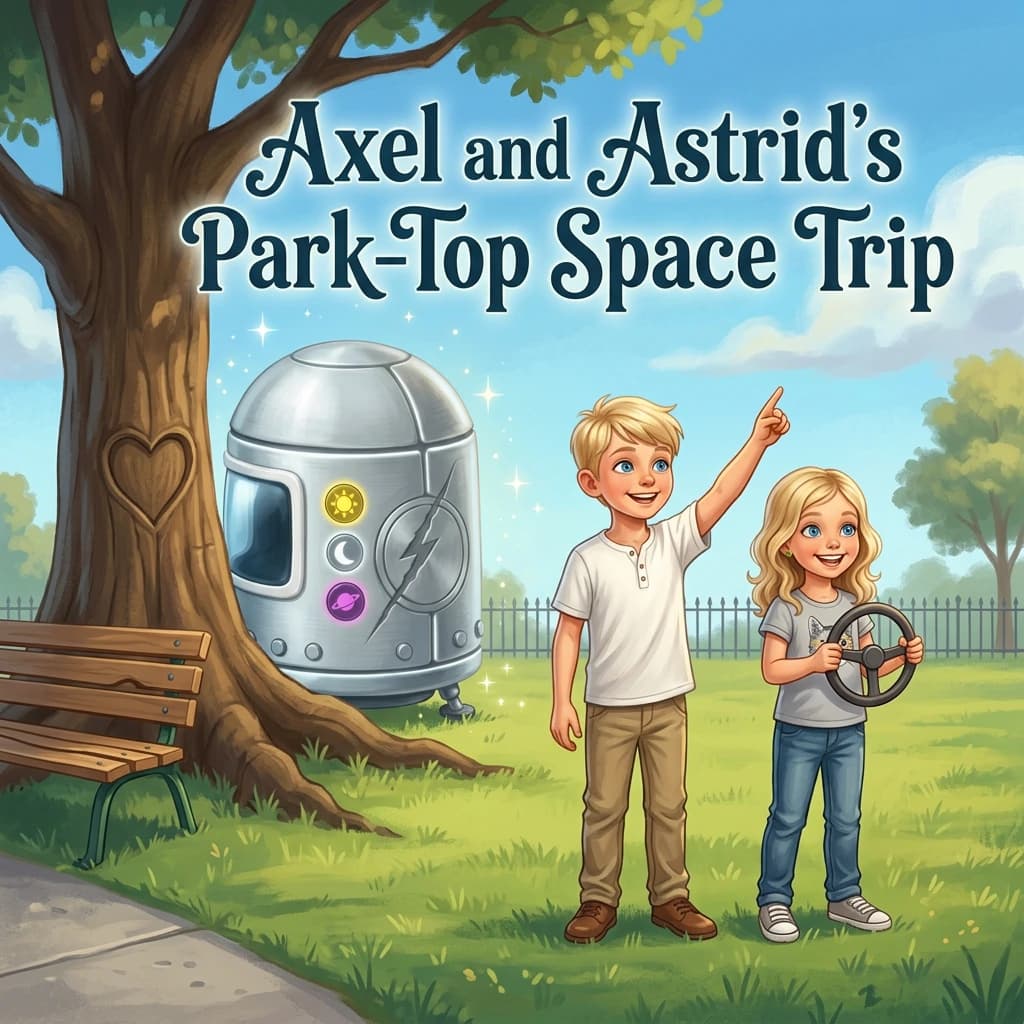
The story begins on a perfectly ordinary Saturday. Axel and Astrid head to the park armed with a notebook and a flashlight, ready to draw constellations. But their quiet afternoon takes a turn when something shiny catches their eye behind the big maple tree.
What they find is a small silver spaceship, humming softly, with three glowing buttons: one with a sun, one with a crescent moon, and one with a ringed planet. The choice is obvious -- they press the sun button together, and the adventure begins.
From there, the two friends lift off from the park and visit the sun, orbit the moon, and cruise past every planet in the solar system before racing home in time for dinner. This solar system story for kids was created by a parent on Lullaby who wanted a way to teach their space-loving children about the planets -- using their own kids as the heroes.

Real Science About the Solar System for Kids
What makes this personalized story special is how naturally it teaches. There's no lecturing -- the science comes through the characters' own curiosity and conversation.
The Sun and Day-Night Cycle
Axel explains that the sun is a giant ball of hot gas and our closest star. According to NASA, the Sun is about 93 million miles from Earth -- a fact Axel shares as their spaceship zooms closer. Astrid pieces together why we have day and night: it depends on which side of Earth faces the sun.
Moon Phases Explained for Children
When they reach the moon, they notice one side is bright and the other dark, leading to a discussion about moon phases that clicks instantly. "Sometimes we see a full moon," Axel explains, "when the sun lights up the whole side facing us. Other times we see only part, like a crescent."
A Tour of All the Planets
The solar system tour brings it all together. The kids fly past Mercury, Venus, Mars, Jupiter, and Saturn, watching each planet in its orbit. Astrid sums it up beautifully: "Our solar system is like a family, with the sun in the middle and the planets all going around together."

After reading, try stepping outside with your child on a clear night. Point out the moon's current phase and see if they can explain why it looks that way -- just like Astrid does in the story.
What Your Child Will Learn from This Space Story
- The Sun is a star -- the closest star to Earth and the center of our solar system
- Why we have day and night -- it depends on which side of Earth faces the Sun
- How moon phases work -- why the moon looks different throughout the month
- The order of the planets -- Mercury, Venus, Earth, Mars, Jupiter, Saturn, Uranus, Neptune
- Teamwork and curiosity -- asking questions is how discoveries happen
Life Lessons Woven Into the Adventure
Beyond the science, this personalized story carries deeper messages that resonate with young readers.
Curiosity leads to discovery. Axel and Astrid don't just stumble onto the spaceship -- they're already out exploring, asking questions, and looking at the sky. The adventure rewards their curiosity, reinforcing the idea that asking "why?" is always worthwhile. It's a pattern we see across stories that help children grow.
Teamwork and friendship. Axel knows the facts; Astrid asks the questions that make those facts click. Together, they understand more than either would alone. It's a gentle model for how collaboration works -- and a great example of why sibling stories resonate so deeply with families.
Responsibility. Even in the middle of the most exciting trip of their lives, Astrid remembers they need to be home for dinner. The story shows that adventure and responsibility can coexist.
Stylized Realism: The Illustration Style Behind This Story
This story uses the Stylized Realism illustration style -- a look that captures a perfect likeness while feeling like art rather than a photograph. For a space adventure, it's an ideal match. The planets glow with vivid color, Saturn's rings glitter, and the view of Earth from above feels both grand and intimate.
Because the characters are based on real children's photos, Lullaby's AI transforms them into illustrated characters that appear on every page. Unlike template-based personalized books, Lullaby uses AI to generate a completely unique story and illustrations from a parent's description. Seeing themselves floating past Jupiter or pressing their nose to the window as the moon approaches makes the science feel real and within reach.
Who This Space Story Is Perfect For
- Ages 4-7 -- accessible language with real science depth
- Kids who love space, rockets, and planets -- this story feeds that passion
- Bedtime reading -- the gentle ending with evening stars is a natural wind-down
- STEM-curious families looking for stories that teach without feeling like a lesson
- Siblings or best friends who love adventuring together
Discussion questions after reading: Ask your child which planet they'd visit first and why. Can they name the planets in order? What would they pack for a trip to space?
Create Your Own Personalized Space Story with Lullaby
Every child deserves to be the hero of their own adventure. With Lullaby, creating a personalized story takes three steps:
- Upload a photo of your child
- Describe the adventure you want them to go on
- Choose an illustration style and let the AI generate a complete, illustrated storybook
Axel and Astrid's trip through the solar system started with a simple idea from a parent who knew their kids loved space. Your child's next favorite bedtime story could start the same way.