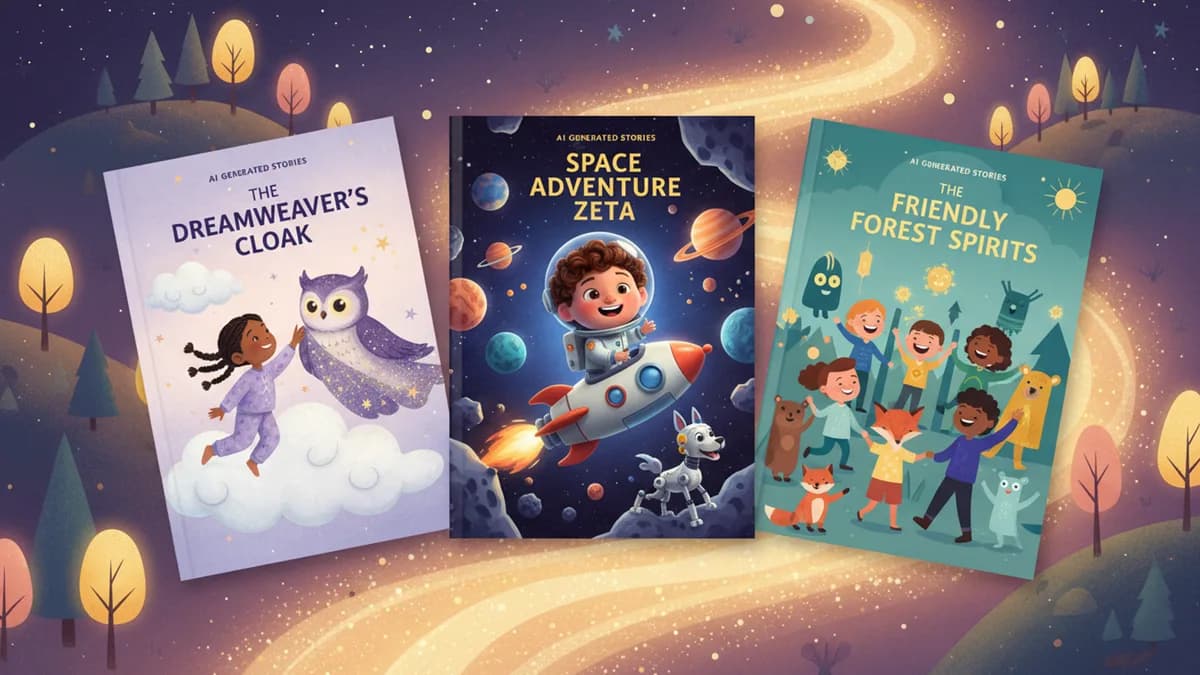
Short answer: yes, Amazon KDP accepts AI-generated children's books — including books where both the story and the illustrations were created with AI. Thousands go live every month.
But there's one rule you cannot skip, one definition worth understanding precisely, and a quality bar that decides whether your book thrives or disappears. Here's the full picture as of 2026.
The One Non-Negotiable Rule: Disclosure
When you publish (or republish) a book on KDP, Amazon's content questionnaire asks whether your book contains AI-generated text, images, or translations. If it does, you must say so.
Three things every nervous first-time publisher should know about this disclosure:
- It's invisible to buyers. Nothing appears on your product page. No badge, no label, no "AI" tag.
- It doesn't affect ranking or royalties. Amazon has stated the disclosure is not used to penalize books in search or earnings.
- It's genuinely enforced. Amazon combines automated detection with human review, and enforcement has tightened notably since 2025. Undisclosed AI content can get a book removed — and repeat offenses can close your whole KDP account.
In other words: disclosing costs you nothing, and not disclosing risks everything. Check the box.
"AI-Generated" vs. "AI-Assisted" — Amazon's Exact Distinction
Amazon's definitions decide what you must disclose:
| Definition | Must disclose? | |
|---|---|---|
| AI-generated | An AI tool created the text, images, or translation — even if you heavily edited the output afterward | Yes |
| AI-assisted | You created the content yourself and used AI only to edit, refine, error-check, or brainstorm | No |
The subtlety that catches people: editing AI output doesn't reclassify it. If Gemini or GPT wrote your first draft and you rewrote half of it, it's still AI-generated in Amazon's eyes. If you wrote the draft and AI polished your grammar, that's AI-assisted.
For a book made with an AI storybook tool like Lullaby — where AI generates both the story text and the illustrations from your prompt and photos — the honest answers are: AI-generated text, yes; AI-generated images, yes. Two checkboxes, thirty seconds, done. If you wrote the story yourself and used Lullaby only to illustrate your own children's book, your words stay exactly as written, so the honest text answer is no and only the images answer is yes.
You're Also Responsible for the Content
Disclosure isn't the only requirement. As the publisher, you confirm that your book:
- Complies with intellectual property rights. Don't publish a book starring characters in Disney shirts or a story "in the style of" a trademarked franchise. (This applies to AI and human-made books equally.)
- Meets Amazon's quality standards. KDP's content guidelines allow removal for a "poor customer experience" — garbled text, six-fingered characters, inconsistent protagonists who change appearance between pages.
- Is yours to publish. Check your AI tool's license. Some story generators keep commercial rights or bury restrictions in their terms. (Lullaby's terms explicitly grant purchasers the right to self-publish their story under their own name.)
The Real Bar Isn't Policy — It's Quality
Amazon's policy question is easy to pass. The market's question is harder: is this a book a child will ask for twice?
The AI children's books that fail on Amazon share the same tells — a protagonist whose face subtly changes on every page, text that reads like a summary of a story rather than a story, illustrations with melted hands in the corners. Reviewers notice, and picture books live and die by reviews.
What to check before you publish, page by page:
- Character consistency — same face, hair, and proportions on every page. This is the hardest problem in AI illustration and the biggest quality gap between tools.
- Story arc — a real beginning, a real problem, a real resolution. Not eight loosely related scenes.
- Details in the corners — hands, background faces, text on signs.
- Read it aloud once. If you stumble, a parent will too.
On Lullaby you can edit any line of text and regenerate any illustration before exporting — do a full pass before you send anything to Amazon, because updating a live KDP book means re-uploading files.
Publishing Checklist for an AI Children's Book
- Create and polish your book — every page reviewed
- Verify you have commercial/self-publishing rights from your tool
- Export KDP-formatted files (Lullaby's Amazon KDP package includes the interior, wraparound cover, and specs README)
- In KDP's content questionnaire, disclose AI-generated text and images
- Preview every page in Amazon's Print Previewer
- Publish — live within ~72 hours
For the full end-to-end process including royalty math, see our complete guide to publishing a children's book on Amazon KDP.
The Bottom Line
Amazon doesn't care that your children's book was made with AI. It cares that you're honest about it and that the book is good. Both are entirely within your control — and the second one is exactly what Lullaby is built for.